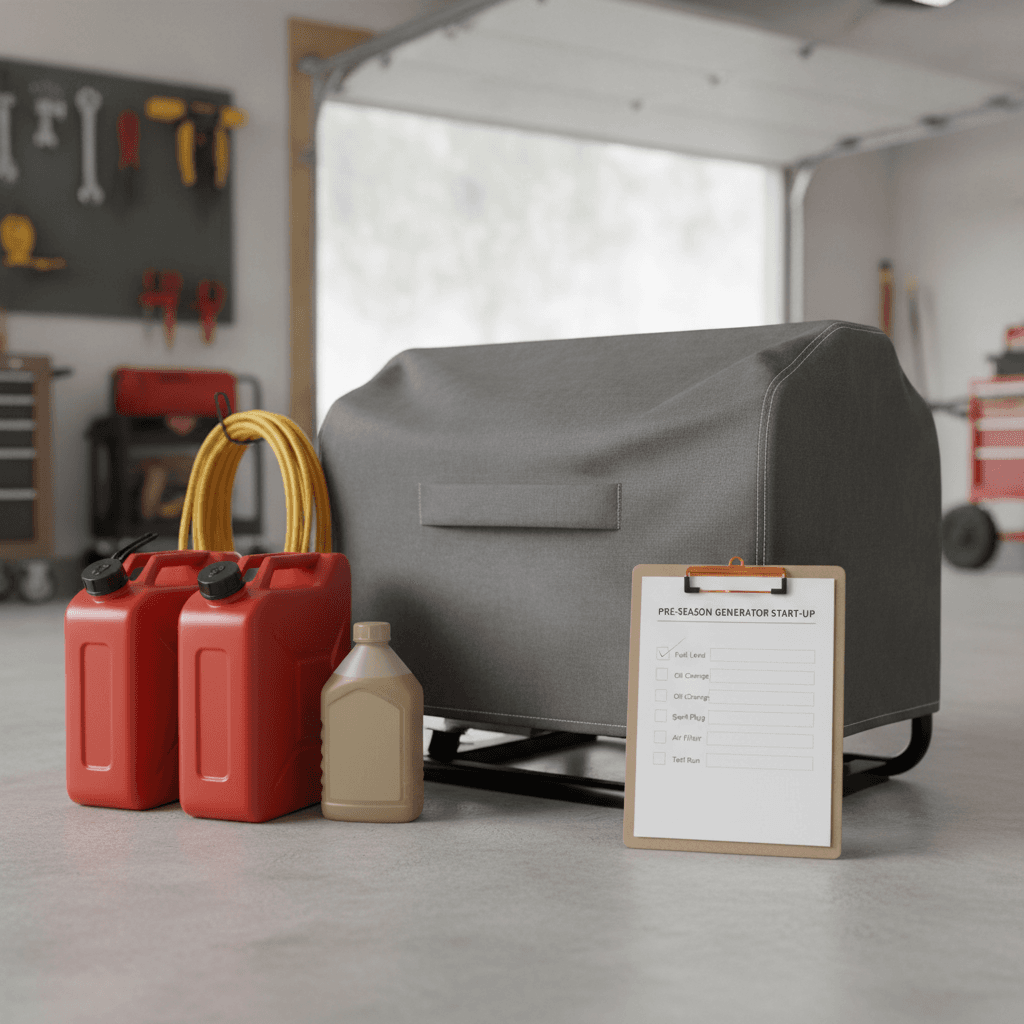
Buy and test your generator in spring, not the week a storm is named. Test runs, fuel storage, cords, and a carbon monoxide plan done early.
Installation
Quick answer: Buy and test your generator in spring, because in the week a storm is named the portables, cords, and fuel cans sell out and prices spike. The spring list is short: a monthly 20-minute test run under load, fuel stored with stabilizer (or propane, which keeps indefinitely), cords and the interlock checked, and a carbon monoxide plan with detectors and a 20-foot placement spot chosen in advance. When a storm is named you just fuel up, run a test, charge everything, and review the CO plan.
Best for
Storm-belt homeowners who already own or are about to buy a portable and want it ready before June, not during a warning.
Wrong fit
Buyers still deciding between standby, portable, or battery, who should settle the outage-pattern question first.
Tradeoff
Prep in spring costs you one quiet Saturday. Prep skipped until a storm is named costs you stock, price, and shipping that all disappear at once.
Buy your generator in spring and test it before June. In the week a storm is named, the portables, extension cords, and fuel cans sell out, prices climb, and shipping stops. The prep that actually keeps the power on is boring and cheap: a monthly test run, fuel stored right, the connection checked, and a carbon monoxide plan decided before you are stressed and improvising in the dark.
This is a service page, not a sales pitch. We don't sell generators. The whole point of the spring list is that you do this work on a quiet Saturday, so a named storm becomes a 48-hour checklist instead of a scramble. If you have not bought yet, the portable shortlist covers the picks worth your money.
Quick Answer: The Spring Prep List
Prep task
When
Why it matters
20-minute test run under load
Monthly
Confirms it starts and runs, keeps fuel fresh
Store fuel with stabilizer, or propane
Spring, then rotate
Gasoline is gone the day a storm is named
Check cords and the interlock
Before June
The connection is what powers the house
Set the CO plan and detectors
Before June
This is the failure mode that actually kills
Fuel up, test, charge everything
48 hours before landfall
Ready without the checkout stampede
Why Spring, Not Storm Week
Storm week is the worst time to buy or prep, and it is the time almost everyone does both. When a name goes on the map, three things happen at once. Portables, cords, and fuel cans clear the shelves within a day. Prices on what is left drift up. Online orders stop arriving in time. You end up paying more for a worse unit, or driving to three stores for a gas can.
Do it in spring and none of that touches you. The generator is already in the garage, already tested, already connected the right way, and the fuel is already stored. You are not competing with your whole county for the last unit. Spring prep is not about fear. It is about not shopping in a panic.
The Monthly Test Run
A generator that sits untouched for a year is the one that will not start when you need it, usually because of stale fuel in the carburetor. The fix is a 20-minute run, once a month, with a real load on it. Plug in a couple of appliances or a space heater so the engine works, not just idles. You are checking three things: that it starts on the first or second pull, that it runs smoothly under load, and that the oil is clean and topped off.
While you are there, look at the air filter and the oil level. Oil changes are the maintenance that owners skip and then regret. If you want the full ownership cost, including oil and service intervals, see the maintenance cost guide.
Fuel Storage: How Much, and How to Keep It
Two questions here: how much, and how to keep it from going bad.
How much depends on how you will actually run it. Most people run a portable 8 to 12 hours a day during an outage, not around the clock. A mid-size portable burns very roughly 0.5 to 0.75 gallons an hour at half load (est.), so a three-day outage can mean 15 to 25 gallons of gasoline. That is three to five 5-gallon cans, and it is exactly why the gas-station lines form the day a storm is named.
How to keep it: untreated gasoline can start to go stale in as little as a month. Add fuel stabilizer and it keeps for up to a year (est.). Store it in approved cans, away from living space and ignition sources, and rotate it through your car every few months so it never sits long enough to matter. Propane is the easy button here. It stores indefinitely and does not degrade, which is a strong argument for a dual-fuel unit. A few spare 20-pound tanks in the spring, topped off, and your fuel problem is mostly solved. The tradeoffs between the two are in natural gas vs propane.
Cords, Interlock, and the Connection
The connection is the part people leave until the lights are already out, and by then it is too late to do it right. If you plan to power hardwired circuits, a furnace, a well pump, your lights, you need an interlock kit (about $400 to $850 installed) or a manual transfer switch. Get that installed and inspected in spring, not during a warning when no electrician is available. The full comparison is in interlock kit vs transfer switch.
Then check the cords. Heavy-gauge, outdoor-rated, long enough to keep the generator well away from the house, and not cracked or frayed from last season. Storm week is when the good cords sell out first, right alongside the fuel cans.
The Carbon Monoxide Plan (decide it before the storm)
This is the part that is not about convenience. It is about whether everyone in the house is alive next week. Portable generators are tied to roughly 80 to 100 carbon monoxide deaths a year in the US, according to the CPSC, and the deaths spike in the days after major storms and outages, when people run a generator too close to the house or, worse, inside it. CO is invisible and has no smell. By the time you feel it, you may not be able to act.
The plan is simple and you decide it now, not at 2 a.m. in the rain:
The generator runs outdoors only, on the ground, at least 20 feet from the house, with the exhaust pointed away from every door, window, and vent. Never in the garage, never on a porch, never under an open window, even with the garage door up.
Working carbon monoxide detectors on every level of the house and near sleeping areas, with fresh batteries you install in spring.
Pick the exact spot the generator will sit before the storm, so no one improvises a closer, more dangerous spot in the dark.
If you want to know what to buy in spring, watch what disappears the day a storm is named. Portable generators go first, especially the mid-size dual-fuel units. Then extension cords and gas cans, which people forget they need until they have the generator home. Then fuel itself, as station lines back up and some run dry. Batteries, coolers, and ice follow. None of it is exotic. All of it is gone in a day. Everything on this list you can buy calmly, in April, at a normal price.
The Named-Storm 48-Hour Checklist
When a storm is actually on the map and you have done the spring work, the last two days are short and calm:
Fuel up. Fill your cans and top off the vehicles while stations are still full.
Run a test under load. Confirm it starts and runs before you are relying on it.
Charge everything. Phones, battery banks, power stations, laptops, and tool batteries.
Check the CO detectors and confirm the 20-foot placement spot.
Confirm the cords and the interlock are ready to go.
If you are on a well, fill jugs and a bathtub, because no power means no pump.
That is the whole storm-week job when the prep is already done. No stampede, no premium prices, no improvising in the dark.
Frequently Asked Questions
When should I buy a generator for hurricane season?
In spring, before the season starts in June. Stock is full, prices are normal, and you have time to test it, store fuel, and get the interlock installed and inspected. Buying during a named storm means paying more for whatever is left, if anything is left, and hoping it starts the first time you ever run it.
How much fuel should I store for a hurricane?
Enough for how you will actually run it. Most people run a portable 8 to 12 hours a day, not 24. A mid-size unit burns very roughly 0.5 to 0.75 gallons an hour at half load (est.), so plan on 15 to 25 gallons for a three-day outage, which is three to five 5-gallon cans. Propane is easier to stockpile because it does not go bad, so a few spare tanks cover you without rotation.
Does gasoline go bad, and how do I store it?
Yes. Untreated gasoline can start to degrade in about a month. Add fuel stabilizer and it keeps for up to a year (est.). Store it in approved cans away from living space and ignition sources, and rotate it through your car every few months. Propane, by contrast, stores indefinitely, which is a real point in favor of a dual-fuel generator.
How often should I run my generator to keep it ready?
About 20 minutes a month, with a real load on it, not just idling. That keeps the fuel fresh, confirms it starts, and surfaces a dead battery or a fouled carburetor in April instead of during the storm. Check the oil and air filter at the same time.
Where do I put a generator so it does not poison us?
Outdoors only, on the ground, at least 20 feet from the house, with the exhaust aimed away from every door, window, and vent. Never in the garage or on a porch, even with the door open. Add working carbon monoxide detectors on every level with fresh batteries. This is the single most important item on the list, so read never run a generator indoors before the season starts.
What sells out first when a storm is named?
Portable generators go first, then extension cords and gas cans, then fuel itself as station lines back up. Batteries and ice follow. All of it is ordinary hardware you can buy calmly in spring at a normal price, which is the entire argument for prepping early.
Should I get dual fuel for hurricane season?
For most storm-belt homeowners, yes. Dual-fuel lets you run on propane when gasoline is scarce or lined up at the pump, and propane stores indefinitely so you can stockpile it in spring. You keep the option to run gas when it is available. The full tradeoff is in natural gas vs propane.
Methodology
These guides are built from manufacturer documentation, public specifications, primary research where health claims matter, and repeated buyer questions that show up in real ownership and installation decisions.
Manufacturer responses can clarify pricing bands, warranty terms, support footprint, or common mistakes. They do not move a page up the shortlist on their own.
Health and safety pages are written conservatively. When the safer answer is to slow down, get clearance, or skip the heat, that is the answer we give.