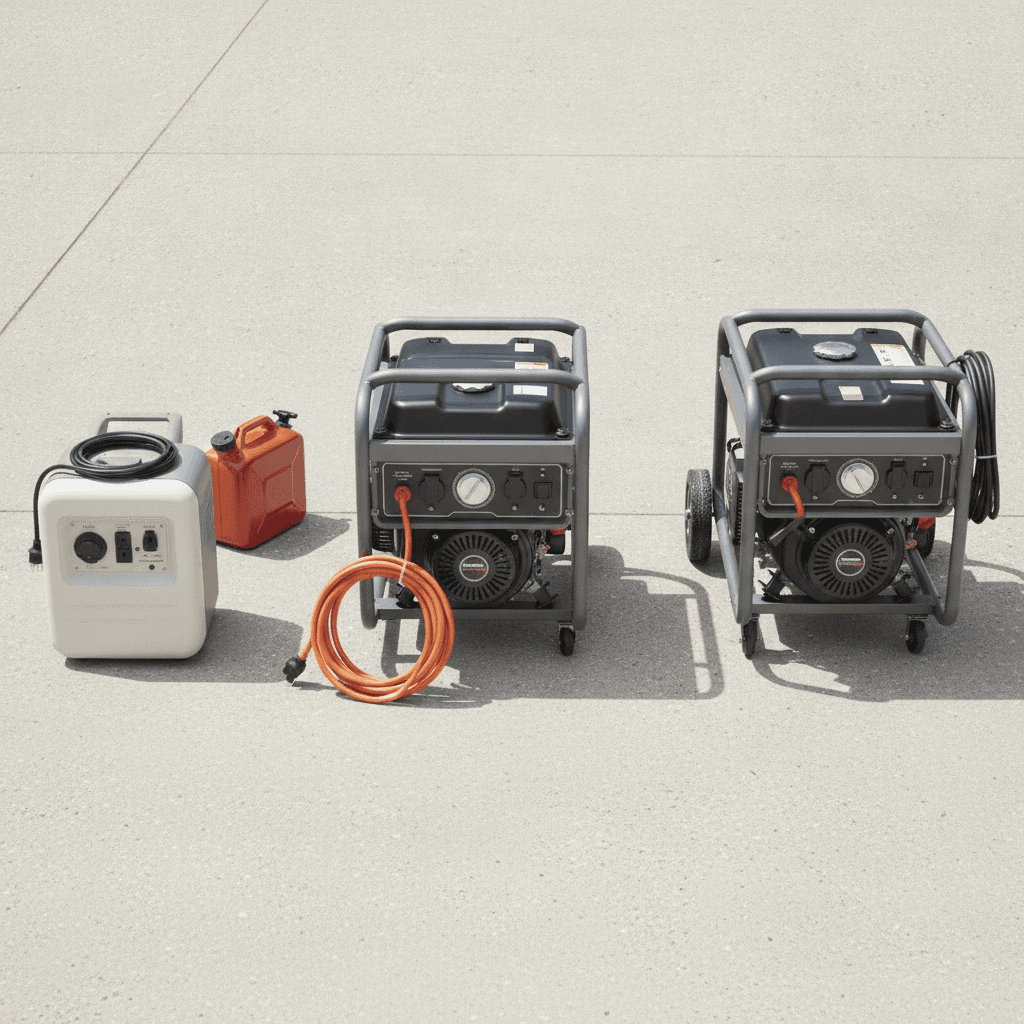
Quiet Honda inverters, Westinghouse value, Champion and DuroMax dual-fuel for storm duty, and the interlock every portable pick actually needs.
Shortlist
Quick answer: For quiet backup that is safe for electronics, a Honda EU2200i (1,800 running watts, around $1,200 est.) or a Westinghouse iGen4500DF inverter is the pick. For storm duty, a well pump, or half the house at once, a Champion or DuroMax dual-fuel open-frame gives you 7,500 to 10,500 running watts for roughly $800 to $1,100 est. Whatever you buy, a portable that powers your panel needs a $400 to $850 interlock installed, and a model with a carbon monoxide shutoff sensor is the safety tiebreaker.
Best for
Buyers who already know a portable, not a standby, fits their outage pattern and want a shortlist of credible brands.
Wrong fit
Buyers facing week-long outages who should price a standby, or short outages where a home battery wins on silence.
Tradeoff
Inverters give you quiet, clean power for fewer watts per dollar. Open-frame dual-fuel gives you more watts and fuel flexibility per dollar, with more noise.
For quiet backup that will not fry your electronics, a Honda EU2200i (1,800 running watts, around $1,200 est.) or a Westinghouse iGen4500DF inverter is the pick. For storm duty, a well pump, or half the house at once, a Champion or DuroMax dual-fuel open-frame gives you 7,500 to 10,500 running watts for roughly $800 to $1,100 (est.). Whatever you buy, one rule ties the shortlist together: a portable that powers your electrical panel needs a $400 to $850 interlock installed.
This is a shortlist, not a catalog. We don't sell generators, so nothing here is ranked by commission. These are the four brands worth your money, sorted by the job: a quiet inverter for electronics and occasional use, or an open-frame dual-fuel workhorse for storm season. Not sure a portable is even the right lane? Read standby vs portable first, or size it in what size generator do I need.
Quick Answer: The Portable Shortlist
Model
Running W
Surge W
Fuel
Noise
Weight
Price (est.)
Best for
Honda EU2200i
1,800
2,200
Gas
Quiet (48-57 dBA)
~47 lb
~$1,200
Electronics, quiet backup
Westinghouse iGen4500DF
3,700
4,500
Gas/Propane
Quiet inverter
~100 lb (est.)
~$800-$1,100
Value inverter, RV crossover
Honda EU7000iS
5,500
7,000
Gas (EFI)
Quiet inverter
263 lb
~$5,000
Premium, near whole-home, quiet
Champion 100891
7,500
9,375
Gas/Propane
Loud (~64-72 dBA est.)
~200 lb (est.)
~$800-$1,100
Storm-duty value
Westinghouse WGen9500DF
9,500
12,500
Gas/Propane
Loud (~64-72 dBA est.)
~211 lb (est.)
~$900-$1,200
Transfer-switch-ready storm duty
DuroMax XP13000EH
10,500
13,000
Gas/Propane
Loud (~64-72 dBA est.)
~236 lb (est.)
~$1,000
Big loads, well pump plus AC
Wattages are running/surge. Weights and street prices are approximate (est.) and move often, so verify current numbers before you buy.
Quiet Inverters for Electronics and Occasional Use
Inverter generators make clean power, under 3 percent total harmonic distortion, which keeps laptops, TVs, and modern appliance boards safe. They are quiet enough to talk over and light enough to carry. You pay more per watt for that. For a fridge, a few circuits, phones, and a router during an outage, it is the right trade. The full breakdown is in inverter vs open-frame.
Honda EU inverter line (the gold standard)
Honda's EU series is the one every other brand gets measured against, and it earns the spot. The EU2200i puts out 1,800 running watts and 2,200 surge, weighs about 47 pounds, and runs at 48 to 57 dBA. Two of them link with a parallel kit for roughly 4,400 watts. Step up to the EU3200i (2,600 running watts, about $2,799 MSRP) or the EU7000iS (5,500 running watts, electric start, around $5,000) for fuel injection and more capacity in the same quiet package.
The knock is the sticker. An EU2200i runs around $1,200 (est.) when a no-name inverter of similar wattage is half that. You are paying for starting reliability, resale value, the dealer network, and the standard CO-Minder shutoff. Lean on it hard or run sensitive gear, and it is worth it. Need one weekend a year of light backup, and a cheaper inverter is a fair call.
Westinghouse iGen4500DF (the value inverter)
Want inverter-clean power with more headroom than an EU2200i but not a Honda price? The Westinghouse iGen4500DF delivers 3,700 running watts and 4,500 surge on gasoline, holds under 3 percent THD, and adds dual-fuel so you can run propane too. It has a remote start and a wheel kit, welcome at roughly 100 pounds (est.). It is the natural crossover unit if you also want it for an RV or a tailgate.
Open-Frame Dual-Fuel for Storm Duty
When the job is a multi-day outage, a well pump, a sump, or powering half the panel through an interlock, open-frame dual-fuel is the value lane. You get far more watts per dollar. You give up quiet, expect roughly 64 to 72 dBA (est.). The THD is higher, which is fine for motors, pumps, heaters, and lights, and riskier for sensitive electronics. Dual-fuel matters because propane stores indefinitely, and gasoline gets scarce exactly when you need it.
Champion dual-fuel (the storm-duty value pick)
Champion's dual-fuel open-frame line is the default value answer for storm backup. A model like the 100891 makes 7,500 running watts and 9,375 surge on gasoline, drops to 6,750 running on propane, has electric start, and is legal in all 50 states. Newer units carry CO Shield, Champion's automatic carbon monoxide shutoff. The warranty and US-based support are genuinely good for the price, which is why it outsells the no-name field. Expect roughly $800 to $1,100 (est.).
DuroMax XP13000EH (the most watts per dollar)
Need a well pump plus a central AC start? You need real surge capacity, and DuroMax sells the most of it per dollar. The XP13000EH makes 10,500 running watts and 13,000 surge on gasoline from a 500cc engine, runs dual-fuel, has a transfer-switch-ready 50-amp outlet, and includes a CO shutoff sensor. Street price sits around $1,000. It is heavy, about 236 pounds (est.), and loud, so it is a park-it-and-cord-it machine. For a big all-in-one storm unit, the value is hard to beat.
Westinghouse WGen9500DF (transfer-switch-ready)
Between those two sits the Westinghouse WGen9500DF: 9,500 running watts, 12,500 surge, dual-fuel, remote electric start, and built transfer-switch-ready. The DFc version adds a CO sensor. It is a clean pick if you want a big open-frame unit that pairs neatly with an interlock or manual transfer switch. Figure roughly $900 to $1,200 (est.).
Every Pick Needs an Interlock
Here is the line item nobody puts on the box. A portable is only as useful as the way you connect it, and extension cords through a cracked window will not power your furnace, your well pump, or your hardwired circuits. To feed the panel safely and legally you need an interlock kit, about $400 to $850 installed, or a manual transfer switch, up to around $1,500. Both let one inlet feed the panel while locking out the main breaker, so you cannot backfeed the grid and kill a lineman. Budget for it the day you buy the generator. The comparison is in interlock kit vs transfer switch.
The CO Shutoff Sensor Is the Real Tiebreaker
If two units are close on your list, let the carbon monoxide sensor break the tie. Portable generators are tied to roughly 80 to 100 carbon monoxide deaths a year in the US, according to the CPSC, and most happen at home when a generator runs too close to the house. A built-in CO shutoff, sold as Honda CO-Minder, Champion CO Shield, DuroMax CO Alert, or Westinghouse's CO sensor models, cuts the engine before the air gets deadly. It does not replace placing the generator outdoors and far from windows, but it is a real backstop. Read never run a generator indoors before your first start.
The Budget Tier: What the Wishful Watts Hide
You will see 10,000-watt open-frame units from brands you have never heard of for a few hundred dollars. The pattern is consistent, so learn the pattern, not fifty names. The surge number is inflated and the running number is what matters. Reviews are often thin or purchased. Parts and warranty support are hard to reach when it fails in year two. Some skip the CO shutoff entirely. That does not make every budget unit junk. It means the price gap is usually missing engineering, support, and safety hardware, not a deal the big brands missed. On a tight budget, a smaller Champion or Westinghouse from a real dealer beats a bigger no-name unit.
Match the Pick to Your Outage Pattern
Two short outages a year for the fridge and phones: a Honda EU2200i or Westinghouse iGen4500DF inverter, plus cords. A well pump, a sump, or a multi-day hurricane risk: a Champion, Westinghouse WGen, or DuroMax dual-fuel open-frame, wired to the panel through an interlock. Medical equipment or a home office: pay up for an inverter and clean power.
When you are ready to compare models and current pricing, the brand directory has the full field. Size it for your outage pattern, not your panic.
Frequently Asked Questions
What size portable generator do I need for a house?
Most homes get through an outage on 5,000 to 7,500 running watts if you stick to essentials: fridge, freezer, furnace blower, well pump, and some lights. Add it up by starting wattage, because motors like a well pump draw two to three times their running watts for a second at startup. A 3,700-watt inverter covers a fridge-and-phones outage. A well pump plus central air pushes you toward 9,000 watts or more. Work it out in what size generator do I need.
Is Honda worth the extra money over Westinghouse or Champion?
For hard, regular use and for sensitive electronics, yes. You are paying for starting reliability, quiet, resale value, and a dealer network, and Honda delivers all four. For light backup a few times a year, a Westinghouse or Champion from a real dealer covers the same job for less, and the savings buy the interlock. Neither answer is wrong. It depends on how hard you will lean on it.
Can a portable generator run my whole house?
A big dual-fuel unit like a 10,500-watt DuroMax can run most of a typical house, though usually not everything at once. You manage loads: run the well pump or the AC, not both in the same instant. What it cannot do is start and stop automatically or carry a large central AC plus everything else the way a standby does. For that, see standby vs portable.
Do I really need an interlock, or can I just use extension cords?
Cords work for a fridge and a lamp. They cannot power anything hardwired, like a furnace, a well pump, or your lights, and stringing enough of them is a trip-and-fire hazard. To power the panel you need an interlock, about $400 to $850 installed, or a manual transfer switch. It is the difference between a generator that runs a cooler and one that runs your house.
What is the quietest portable generator for backup?
Enclosed inverter generators are the quiet class, roughly 48 to 60 dBA at 23 feet, and the Honda EU line sits at the quiet end at 48 to 57 dBA. Open-frame units run louder, around 64 to 72 dBA (est.), which is a real factor in a tight neighborhood or under HOA noise rules. If quiet matters, buy an inverter and accept fewer watts per dollar.
Are the cheap 10,000-watt generators on Amazon any good?
Treat the wattage on those listings as marketing until proven otherwise. The surge rating is usually inflated, the running watts are what count, and the thin support and missing CO shutoff are where the low price comes from. Some are fine. Many are not, and you find out in year two. A smaller unit from Champion, Westinghouse, Honda, or DuroMax through a real dealer is the safer money.
Methodology
These guides are built from manufacturer documentation, public specifications, primary research where health claims matter, and repeated buyer questions that show up in real ownership and installation decisions.
Manufacturer responses can clarify pricing bands, warranty terms, support footprint, or common mistakes. They do not move a page up the shortlist on their own.