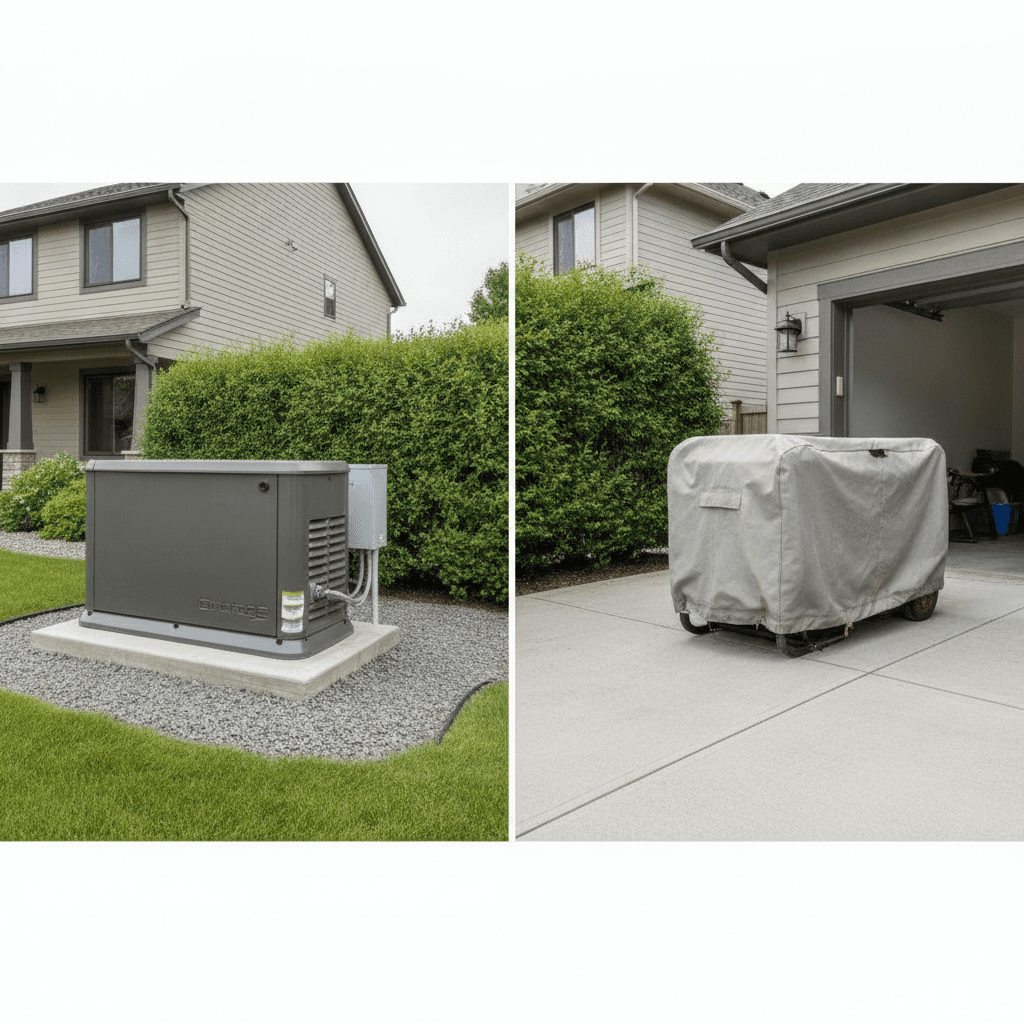
The lane decision is your outage pattern. Standby runs $12,000 to $18,000 installed and hands-off. Portable plus interlock, $1,500 to $3,500.
Setup Type
Quick answer: It comes down to your outage pattern. If you lose power a few times a year for hours, a portable plus an interlock kit, $1,500 to $3,500 all-in, is the best value in backup power. If you lose it for days at a time, or you have a well pump, medical equipment, or you travel, a standby at $12,000 to $18,000 installed starts itself and runs as long as the fuel lasts. A home battery is the third lane for short, silent, indoor-safe backup.
Best for
Buyers deciding between a permanent standby and a portable, keyed to how often and how long their power actually goes out.
Wrong fit
Buyers who already picked their lane and want the size, the brand shortlist, or the installed quote.
Tradeoff
A portable is a fraction of the price and you run it yourself in the weather. A standby costs as much as a used car and you never touch it.
The choice comes down to one thing: your outage pattern. If your power blinks out a few times a year for a few hours, a portable plus an interlock kit, $1,500 to $3,500 all-in, is the best value in backup power, and it is not close. If your power goes out for days at a stretch, or you have a well pump, medical equipment, or you travel and cannot be home to run a machine, a standby at $12,000 to $18,000 installed earns its keep.
Most buyers get sold the size of their fear instead of the shape of their outages. So before you price anything, answer two questions. How often does your power actually go out, and for how long. That picks your lane.
Quick Answer: Standby vs Portable
Portable + interlock
Standby
All-in cost
$1,500-$3,500
$12,000-$18,000 installed
Starts itself
No, you start and connect it
Yes, automatic in seconds
Runs for days
Yes, if you keep fuel on hand
Yes, on the gas line
Fuel
Gasoline or propane you store and pour
Natural gas or a propane tank, no pouring
Noise
Loud, it sits in the yard
Quieter, but a weekly self-test
You have to be home
Yes
No
Right buyer
Outages a few times a year, hours to a couple of days
Multi-day outages, well pump, medical needs, frequent travel
Read down the "right buyer" row first. If you see yourself in the portable column, you can stop reading and save five figures. If you are in the standby column, the rest of this guide is about spending that money well.
Start With Your Outage Pattern, Not the Sticker Price
Two numbers decide this, and neither is on a spec sheet.
Frequency: how many times a year do you lose power. Look back over the last two or three years and count.
Duration: when it goes, is it back in an hour, or are you out for two days. A metro grid with the occasional summer blink is a different world from a rural line at the end of a wooded road, or a hurricane coast where "out" means four days.
A portable covers short, occasional outages beautifully and cheaply. A standby earns its price when outages are long, frequent, or happen while you are not home. Everything else is detail.
The Portable Lane: $1,500 to $3,500 All-In
Here is the real all-in number, not the box price. The machine is $700 to $2,500 for a solid dual-fuel or inverter unit in the 5,000 to 7,500 watt range. The part nobody mentions is the connection. An interlock kit runs $400 to $850 installed, and it is what lets you power your home's circuits safely instead of running cords through a window or, far worse, backfeeding through a dryer outlet and putting a lineman's life at risk.
Add those together and a portable setup is $1,500 to $3,500 done right. For that you get real backup for the fridge, the heat, the well or sump pump, and the lights, on a machine you start and connect yourself in a few minutes when the power drops.
Who it is right for: homeowners with occasional outages, measured in hours to a couple of days, who are physically able to roll out a generator, and who are usually home when the lights go. That is a large share of the country.
A standby is the hands-off option. It sits on a pad outside, wired to an automatic transfer switch and fed by your natural gas line or a propane tank. When the power drops it starts itself within seconds, whether you are home or on a beach three states away, and it runs for days without anyone pouring fuel.
The price you have to plan for is the installed price, not the machine. A 22 to 24 kW standby is a few thousand dollars as a box. By the time you add the concrete pad, the gas line sizing, the transfer switch, the electrician, the plumber, and the permits, the project lands at $12,000 to $18,000. The install costs about as much as the machine, and nobody's product page tells you that. We break it down in the real cost of a whole-house generator.
Who it is right for: multi-day outages, a well pump you cannot live without, medical equipment, or a household that travels and needs backup that runs itself. If your power goes out for four days after every big storm, a standby is not a luxury, it is the tool for the job.
The trade: it is a five-figure project with permits and two trades, plus a weekly self-test that burns a little fuel and a $200 to $400 a year service habit. When those fit, you never think about power again.
The Third Lane: A Home Battery
There is a quieter option that suits a specific buyer. A home battery stores power and switches over instantly, silently, with no fuel and no fumes. For short outages, an HOA that bans a running generator, or a home with no gas line, a battery can be the better answer, especially paired with solar that refills it each day.
The catch is duration. Without solar, a battery is a countdown timer in a long outage. It is excellent for hours, not for a four-day hurricane. We cover the full split in generator vs home battery, and our sister site homebattery.guide goes deep on sizing and solar pairing if the battery lane is calling you.
Two Outage Patterns, Two Answers
"Six hours, twice a year"
Suburban grid, a couple of short outages a year, usually summer storms, and someone is almost always home. This buyer does not need a standby. A 7,500 watt dual-fuel portable and a $600 interlock, about $2,000 to $2,800 all-in, keeps the fridge, the furnace, the internet, and the lights on through every outage this house has seen. Spending $15,000 to automate six hours a year is buying convenience you will use twice. Put the difference somewhere it matters more.
"One week-long hurricane outage"
Gulf coast, a well pump, and when a hurricane hits, the power is gone for four to seven days and the family sometimes evacuates. This is the standby buyer. A portable can bridge a day or two if someone is home to refuel it, but nobody wants to be pouring gasoline every few hours for a week, and it does nothing if the house is empty. A standby at $12,000 to $18,000 installed, running on the gas line or a big propane tank, is sized exactly for this pattern. Pair it with hurricane season prep and it is the last time that outage is a crisis.
Frequently Asked Questions
Is a standby generator worth it over a portable?
It depends entirely on your outage pattern. If you lose power for days at a time, have a well pump or medical equipment, or travel and cannot run a machine yourself, a standby at $12,000 to $18,000 installed is worth it. If your outages are a few short ones a year and you are usually home, a $1,500 to $3,500 portable does the same job for a fraction of the money.
How much does a whole-house standby generator cost installed?
Plan on $12,000 to $18,000 installed for a 22 to 26 kW system. The machine itself is a few thousand dollars. The rest is the concrete pad, gas line, automatic transfer switch, electrician, plumber, and permits. The install costs about as much as the machine, which is why the sticker price on the box is misleading.
Can a portable generator power my whole house?
It can power the essentials of most homes, the fridge, heat, well or sump pump, and lights, through an interlock kit wired to your panel. It will not run central air plus everything at once. A 5,000 to 7,500 watt portable connected legally covers what matters in an outage for the large majority of homes.
How often do I have to refuel a portable generator during an outage?
Roughly every 8 to 12 hours at a moderate load, depending on the tank and how much you are running. Dual-fuel units on a large propane tank stretch that further. This is the real limit of the portable lane. For a multi-day outage someone has to be home to keep it fed, which is exactly where a standby pulls ahead.
Do I need an electrician for a portable generator?
For a safe, legal connection, yes, once. An interlock kit or manual transfer switch has to be installed at your panel by an electrician, usually $400 to $850 for an interlock. After that you connect the generator yourself with one cord and a flip of the interlock. What you must never do is backfeed through a dryer or range outlet, which can kill a utility lineman.
What is an interlock kit and do I need one?
An interlock kit is a metal plate on your electrical panel that lets you safely power your home's circuits from a portable, while making it physically impossible to backfeed the grid. If you want a portable to run your house wiring instead of extension cords, then yes, you need an interlock or a transfer switch. The full comparison is in interlock kit vs transfer switch.
Should I get a battery instead of a generator?
For short, silent, indoor-safe backup, especially with solar or an HOA that bans generators, a home battery can be the better call. For multi-day outages it runs down, so a generator wins on duration. Many homes end up with a battery for daily blips and a portable for the rare long outage. See generator vs home battery.
Methodology
These guides are built from manufacturer documentation, public specifications, primary research where health claims matter, and repeated buyer questions that show up in real ownership and installation decisions.
Manufacturer responses can clarify pricing bands, warranty terms, support footprint, or common mistakes. They do not move a page up the shortlist on their own.