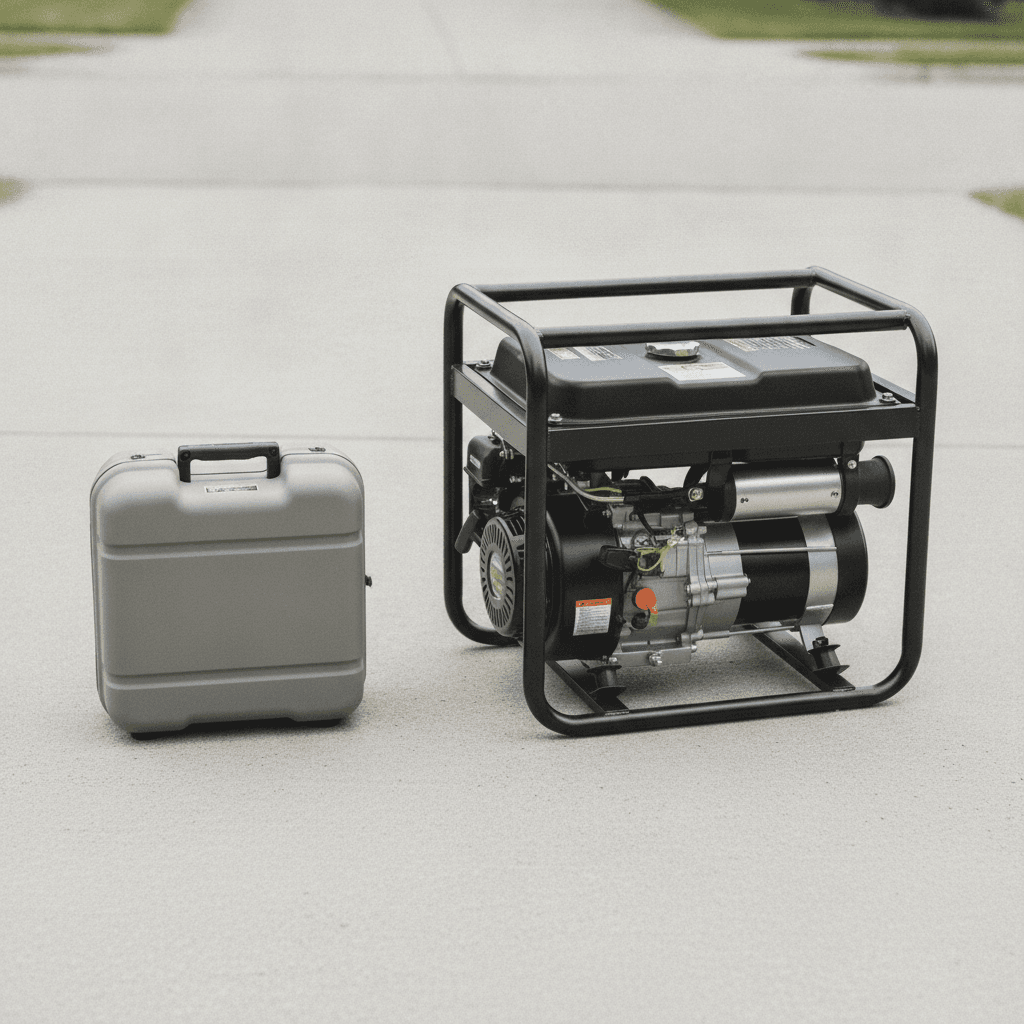
Inverter vs Open-Frame Generator: Real Differences
Inverter means clean, quiet power for electronics. Open-frame means more watts per dollar and more noise. Which one actually fits your loads.
Setup Type
Quick answer: An inverter generator makes clean power (under 3 percent THD, safe for laptops and TVs), runs quieter (around 48 to 60 dBA at 23 feet est.), and weighs less, but costs more per watt. An open-frame generator gives you more watts per dollar and runs louder (roughly 64 to 72 dBA est.) with higher THD that is fine for motors and heaters but risky for sensitive electronics. Buy the inverter for electronics, quiet, and HOA noise limits. Buy open-frame for storm duty, a well pump, or a workshop. Dual-fuel versions exist in both types.
Best for
Buyers deciding which portable type to shortlist before they get attached to a specific model or wattage.
Wrong fit
Buyers who already know their type and want the model shortlist, or those weighing a standby install instead.
Tradeoff
You are trading clean, quiet power against watts per dollar. Inverters win on power quality and noise. Open-frame wins on raw output for the money.
The difference most people learn after they buy: an inverter generator makes clean, quiet power that is safe for electronics, and an open-frame generator makes more watts per dollar with more noise. Inverters hold under 3 percent total harmonic distortion and run around 48 to 60 dBA at 23 feet (est.). Open-frame units are louder, roughly 64 to 72 dBA (est.), with higher THD that is fine for motors and heaters but risky for laptops and modern appliance boards. Neither is better. They fit different jobs.
This is the distinction taught before purchase instead of after, so you buy the right type the first time. We don't sell generators, so this is not a nudge toward the pricier lane. Plenty of buyers are right to skip the inverter premium. Once you know your type, the models worth your money are in the portable shortlist.
Quick Answer: Inverter vs Open-Frame
Factor
Inverter
Open-frame
Power quality (THD)
Under 3% (safe for electronics)
Often 5% to 25% (est.)
Noise at 23 ft
~48 to 60 dBA (est.)
~64 to 72 dBA (est.)
Weight
Lighter, often carry-able
Heavier, usually wheeled
Watts per dollar
Lower
Higher
Parallel kit to add capacity
Common
Rare
Dual-fuel option
Yes
Yes
Best for
Electronics, camping, quiet zones
Storm duty, well pump, workshop
What an Inverter Actually Does Differently
An open-frame generator spins an engine at a fixed speed and sends that raw AC straight to the outlet. An inverter generator takes the engine's output, converts it to DC, then rebuilds a clean AC sine wave with electronics. That extra step is the whole story, and it buys you three things.
Clean power (low THD)
Total harmonic distortion measures how close the power is to the smooth wave your utility delivers. Under 3 percent is considered safe for sensitive electronics: computers, TVs, audio gear, and the control boards inside modern fridges and furnaces. Inverter generators consistently sit under 3 percent. Power in the 6 to 30 percent range is not recommended for sensitive electronics and can shorten their life or fry them outright. If your outage plan includes a laptop, a home office, a gaming console, or medical equipment, clean power is the reason to buy an inverter.
Quieter
Inverters throttle the engine up and down to match the load instead of running flat out, and most are wrapped in a sound-dampening enclosure. The result is roughly 48 to 60 dBA at 23 feet (est.), around the level of normal conversation. Open-frame units, with the engine out in the open and running at a fixed speed, land closer to 64 to 72 dBA (est.). Decibels are a logarithmic scale, so that gap is larger than the numbers make it look. In a tight neighborhood, a campground, or anywhere with HOA noise rules, the quiet is worth real money.
Lighter, and parallel kits double capacity
Inverters pack more power into less weight. A 2,200-watt inverter can weigh under 50 pounds and travel in one hand, where a comparable open-frame unit is bulkier. And most inverters accept a parallel kit: link two identical units and roughly double your capacity. That lets you buy one quiet, portable unit now and add a second later instead of buying one big, heavy machine up front.
Where Open-Frame Wins
Open-frame is not the budget consolation prize. For the right job it is the smarter buy, and the reason is simple: more watts for the money.
More watts per dollar
Dollar for dollar, open-frame gives you more running and surge wattage. A dual-fuel open-frame unit in the $800 to $1,100 range (est.) can deliver 7,500 to 10,500 running watts, enough for a well pump, a sump, a water heater, and much of the panel. Matching that wattage in an inverter costs considerably more. If your job is raw output, storm duty, or big motor loads, open-frame is where the value lives. Size it right first with what size generator do I need.
Higher THD, and when that actually matters
Open-frame THD commonly runs in the 5 to 25 percent range (est.), higher than an inverter. Here is the part that keeps it from being a dealbreaker: motors and resistive loads do not care. A well pump, a sump pump, a furnace blower, a water heater, power tools, and incandescent or heater loads run fine on it. The risk is narrow and specific, and it is sensitive electronics: laptops, TVs, gaming consoles, and some modern appliance control boards. If those are on your list, either buy an inverter or protect them behind a quality surge and power-conditioning device.
Who Genuinely Needs an Inverter
Buy the inverter if any of these describe you. You will run laptops, a home office, a TV, or a gaming setup during outages. You need to power medical equipment. You camp or tailgate and want one unit that crosses over. You live somewhere noise matters, a dense neighborhood, an RV park, or an HOA with sound limits. For all of those, the clean power and the quiet are not luxuries, they are the reason the generator works for your situation.
Who Is Fine With Open-Frame
Buy the open-frame if your job is backup muscle. A multi-day outage where you need to run a well pump, a sump, a fridge, and half the house through an interlock. A garage or workshop running power tools. Any situation where watts per dollar beats quiet, and a laptop is not the priority. You save real money and put it toward wattage or the connection. That is the correct trade for a lot of storm-belt homes, and there is nothing second-rate about it.
Dual-Fuel Comes in Both Types
Dual-fuel, running on either gasoline or propane, is not tied to one type. You will find it on open-frame units like the Champion and DuroMax dual-fuel line, and on inverters like the Westinghouse iGen4500DF. So the fuel question and the type question are separate decisions. Pick your type based on power quality and noise, then decide on dual-fuel based on how you store fuel and how long your outages run. Propane stores indefinitely, which is why it is popular for storm backup. The full tradeoff is in natural gas vs propane.
Whichever type you land on, place it outdoors and far from the house, every time. The type does not change the carbon monoxide rules, which are covered straight in the generator safety guide.
Frequently Asked Questions
What does THD mean, and why should I care?
THD, or total harmonic distortion, measures how clean the power is compared to your utility's smooth sine wave. Under 3 percent is safe for sensitive electronics. Above roughly 6 percent, computers, TVs, and modern appliance boards can misbehave or wear out early. Inverter generators stay under 3 percent. Open-frame units run higher, which is fine for motors and heaters and risky for electronics.
Will an open-frame generator damage my electronics?
It can, over time, for the sensitive stuff: laptops, TVs, gaming consoles, and some appliance control boards. Motors and resistive loads like pumps, blowers, water heaters, and tools are fine on open-frame power. If you need to run electronics off an open-frame unit, put a quality surge and power-conditioning device between them, or step up to an inverter for that job.
Are inverter generators worth the extra cost?
If you run electronics, need quiet, or want a light unit that crosses over to camping, yes. The clean power and low noise are exactly what you are paying for. If your job is storm backup and big motor loads, an open-frame unit gives you more watts for the money and the extra cost is hard to justify. It comes down to the loads, not the badge.
Why are inverter generators so much quieter?
Two reasons. They throttle the engine up and down to match the load instead of running at a fixed speed, and they are usually built inside a sound-dampening enclosure. Together that drops them to around 48 to 60 dBA at 23 feet (est.), roughly conversation level, versus 64 to 72 dBA (est.) for a typical open-frame unit.
Can I run a whole house on an inverter generator?
You can get close with a large inverter or two smaller ones linked with a parallel kit, but it costs more than an equivalent open-frame unit. For whole-house-scale wattage on a budget, open-frame dual-fuel is usually the better value, wired to the panel through an interlock. For hands-off whole-house backup, look at standby vs portable instead.
Do inverter and open-frame both come in dual fuel?
Yes. Dual-fuel is available in both types, so you can have a quiet inverter that runs on propane or a high-wattage open-frame unit that does the same. Choose the type for power quality and noise, then choose dual-fuel based on how you store fuel and how long your outages tend to run.
Methodology
These guides are built from manufacturer documentation, public specifications, primary research where health claims matter, and repeated buyer questions that show up in real ownership and installation decisions.
Manufacturer responses can clarify pricing bands, warranty terms, support footprint, or common mistakes. They do not move a page up the shortlist on their own.